
For decades, global production has been split across countries and companies to keep costs as low as possible. This has made production more efficient. But it has also created dependence on complex supplier networks that few companies fully control.
According to Kjell Inge Bjerga, Professor of Defence History, this is now changing. In security policy, value chains are no longer seen only as business infrastructure. They are increasingly seen as strategic tools.
– Gaining access to value chains, and gaining control over them, has become a tool in modern warfare. Outsourcing and just-in-time production were long seen as the gold standard. Today, they can also create risk, he says.
Bjerga believes the situation is serious. It has made Norwegian control far more important than before.
– We are in a state of preparedness we have not seen since the Cold War. At that time, there was also strong focus on full Norwegian control of everything related to defense and national security.

The Bergen Engines case in 2021 became a wake-up call for Norway. The planned sale of the engine factory to the Russian-controlled company TMH International was stopped by the Norwegian authorities due to concerns about national security and allied defense interests.
Professor Kjell Inge Bjerga says the case revealed weak points in how Norway controlled ownership and supplier networks.
– There were five or six ministries that could have acted earlier, but no one had overall responsibility, he explains.
After the case, the Norwegian government appointed a committee to review how foreign investments should be screened. Bjerga played a key role in the committee. It proposed a new law on investment control to protect national security. According to Bjerga, Norway is one of very few countries that still does not have such a law.
– The case has clearly changed how we think. Norway has become very focused on keeping unwanted actors out of value chains. In the threat assessments from the Norwegian Intelligence Service, the Police Security Service and the National Security Authority, business transfers are now described as a major risk.
This development creates new demands for suppliers, especially in the defense sector. Major procurement projects are no longer only about choosing the right equipment at the right price. They are also about national security, long-term capability and resilience.
Control of competence, critical components and global supply risk has become essential.
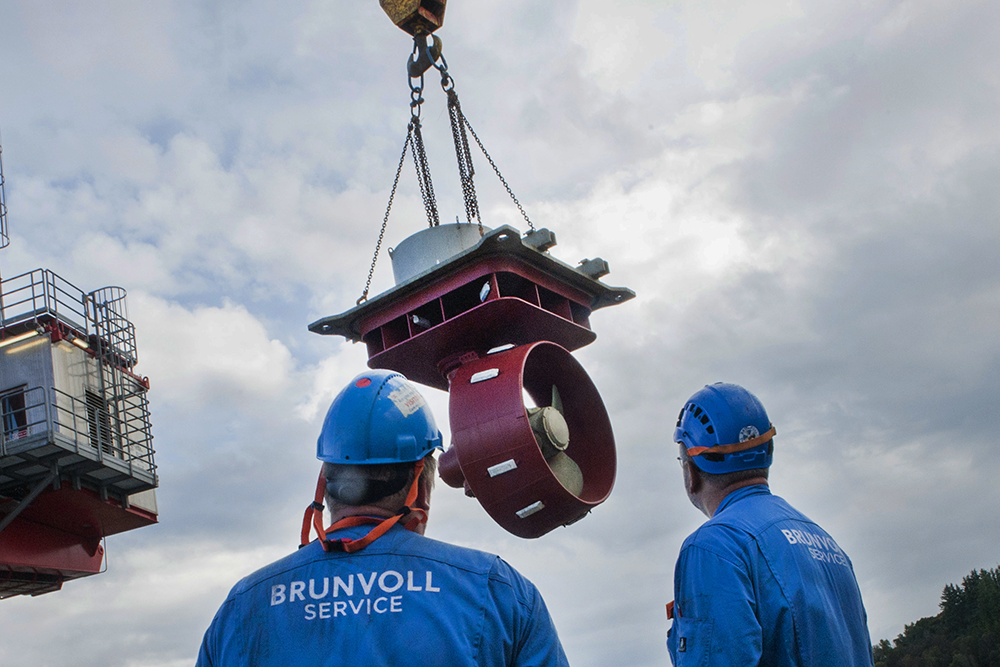
Brunvoll is a Norwegian supplier of propulsion, manoeuvring and positioning systems for advanced vessels. The company keeps development, production and testing in Norway. Group CEO Kåre Øyvind Vassdal says this gives Brunvoll a strong position as value chain control becomes more important.
– Brunvoll has a fully integrated value chain in Norway, from development to production, assembly and testing. This makes us efficient, reduces risk and supports reliable delivery over time. For customers with high demands for operation and preparedness, including the defense sector, that is critical.
Vassdal says Brunvoll’s Norwegian value chain is not only a historic strength. It is also a priority in the company’s current strategy period.
– We have planned an investment programme of NOK 1 billion in the value chain. The goal is to build capacity and strengthen our production and presence in Norway.
In the Norwegian public procurement project for standard vessels, up to 28 vessels will be built for the Royal Norwegian Navy. They will operate for several decades and will need service, spare parts and upgrades throughout their lifetime.
Vassdal believes this is where Brunvoll’s value chain can make a real difference.
– We have full control of our value chain because it is fully integrated under the same roof here in Norway. Value chain control is not something you can buy afterwards. It must be built over time, and that is what we have done from the start.

Professor Kjell Inge Bjerga believes Norway is now in a situation where national industrial control is again becoming vital for security.
– If you do not control who supplies you, you do not control the risk, he says.
He also points to an opportunity.
– The authorities can use public procurement to strengthen Norwegian industry and national security at the same time.

The planned sale of Bergen Engines to the Russian-controlled company TMH International in 2021 created major political debate in Norway. Norwegian authorities assessed that the technology, customer base and strategic importance of the company could have consequences for national security and allied defense interests.
The Norwegian government therefore stopped the sale under the Security Act in March 2021. The case became one of the most discussed examples in Norway of state intervention in a foreign acquisition for security policy reasons.
The committee assessed whether Norway has a strong enough framework to control foreign investments that may threaten national security interests. It proposed, among other things, a new law on investment control.
Large, critical suppliers may already fall under the Security Act. Smaller suppliers that are not defined as critical may fall outside it. In simple terms, the proposed new law would regulate companies and investments that are not covered by the Security Act.


