
The NOx Fund has made several big changes to its support for emission-reducing measures. They come into effect as of the 24th of November.
The aim is to make it more attractive for companies to carry out measures that reduce NOx emissions along the Norwegian coast.
For vessels still operating with older engines, this gives shipowners a much-needed financial boost in carrying out upgrades than before. But replacing the engine is not necessarily the only thing that should be assessed, according to Sales Manager Retrofit Mads Egseth Melbø.
– Vessels often change operating profile over time. Service vessels, fishing vessels and cargo vessels have often been assigned new duties, adopted different operating patterns or faced new requirements for speed, capacity and energy efficiency. This may mean that the current gear ratio, propeller or control system is no longer optimally matched to the vessel’s actual operation.
– Engine replacement can be an excellent opportunity to upgrade the entire propulsion system. Doing this can give you a massive improvement in both emissions, energy consumption and operational efficiency, says Melbø.
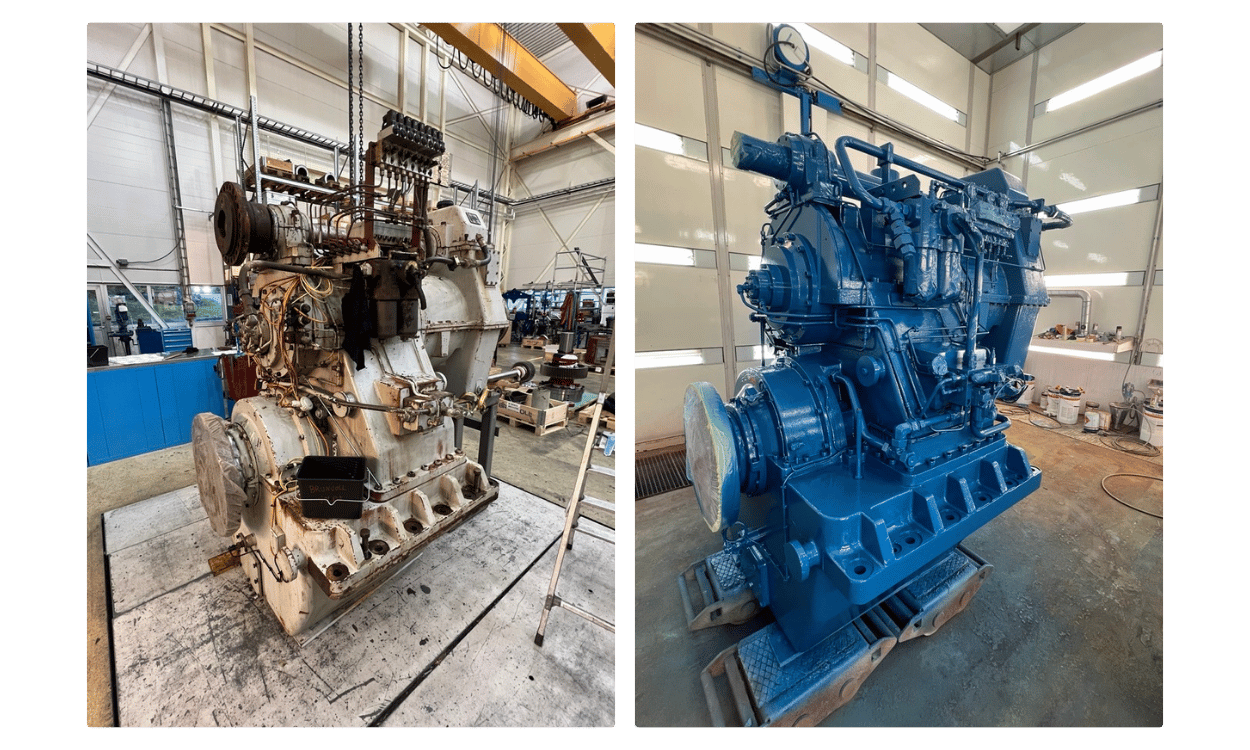
Upgrading can mean replacing, but it can also mean just improving the equipment you have. On the fishing vessels Kågtind II and Båtsfjord, Brunvoll rebuilt and reclassed existing gearboxes when the vessels received new main engines. In such projects, it may be possible to retain key components while the vessel gains the benefits of a modern engine installation and a more efficient propulsion system.
Curious if this applies to you? Contact our experts below.
A good example of how emission reduction and energy use go hand in hand can be found in the projects on the vessels Link Galaxy and Link Nova. The measures include, among other things, lengthening the vessels by 25 meters, a new gear ratio for lower propeller speed, new propellers adapted to the current operating profile, and a new dynamic control system, optimized propulsion. Link Galaxy has recently been completed, while Link Nova is currently undergoing a corresponding conversion.
The main objective of the project was not engine replacement, but to adapt the vessels to a new operating profile. The vessels were originally built for a service speed of around 17 knots and with Ice Class 1A Super. Today, they operate at a significantly lower service speed, while the ice-class requirements have been reduced.
The vessels were lengthened by 25 metres, and a new gear ratio was installed for lower rotational speed, along with new propellers adapted to the operation and a new dynamic control system and propulsion optimization (optimized propulsion).
– When the propulsion system is based on the vessel’s actual operating pattern, significant environmental and operational gains can be achieved.
LINK GALAXY: Lengthening the ship by 25 meters was one of the measures in adapting the ship to the current operating profile.
For shipowners considering engine replacement or other emission-reducing measures, the work often starts with identifying where the greatest gains can be found.
– Our experience is that the greatest gains are often achieved when engine replacement, emission reduction and optimization of the propulsion system are assessed together as part of one integrated project, says Melbø.
Brunvoll assists with propulsion system analyses, technical assessments, concept development and the execution of conversion projects, and the new NOx terms may make more projects financially attractive.
Find our contact information at the bottom.


Sales Manager Retrofit, Brunvoll Volda AS


